
In the heart of the Apuan Alps, among the white marble walls that have shaped the landscape and identity of Carrara for centuries, one of Italy’s most iconic gastronomic products is born: Lardo di Colonnata PGI. Simple and essential, yet deeply rooted in its territory, this product tells a story of labour, ingenuity, and raw material. Today, that same tradition has found a place at the centre of haute cuisine and the most exclusive tables, proving that tradition itself can evolve into contemporary luxury.
The production process of Lardo di Colonnata has remained almost unchanged over time. Its secret lies not only in the quality of the pork fat or in the blend of salt, spices, and aromatic herbs, but above all in the marble vats of Carrara in which it is cured. These vats, carved from single blocks of marble, are far more than containers: they are an essential tool in the process. Marble, a noble material by definition, ensures a constant temperature, allows for slow and natural maturation, and becomes an integral part of the final product.
Historically, lardo was the daily nourishment of marble quarry workers. Bread and lardo provided the energy needed to endure the physically demanding labour in the quarries. It was a humble, functional food, with no gastronomic ambition. Yet it is precisely in this modest origin that its identity is forged. Lardo di Colonnata is a product born out of necessity, refined over time through artisanal knowledge and an intimate dialogue with the territory.
In recent years, Lardo di Colonnata has been rediscovered and reinterpreted by some of Italy’s most influential chefs, emerging as a refined element of Michelin-starred cuisine and a powerful symbol of how memory can be transformed into innovation.
For Massimo Bottura, lardo becomes a narrative tool rather than a simple fat: used with restraint, it adds depth and emoMonal resonance to lean meats and vegetables, elevating a humble ingredient into cultural luxury. Enrico Crippa approaches it with precision and lightness, slicing it paper-thin so it melts naturally into vegetables and herbs, achieving elegance through balance rather than excess.
Within Norbert Niederkofler’s Cook the Mountain philosophy, lardo acts as a bridge between past and present, an ancestral source of nourishment that reflects respect for Mme, territory, and nature. Carlo Cracco highlights its aesthetic and technical potential, using lardo to wrap, protect, and enhance delicate ingredients, adding texture and luminosity perfectly aligned with the language of contemporary luxury dining.
Finally, Davide Oldani interprets Lardo di Colonnata as accessible luxury. Through his Cucina POP, minimal technique and clarity of flavour transform it into a noble seasoning for bread, rice, and vegetables, reaffirming that true luxury lies in balance rather than complexity.
What unites these chefs is a shared conviction: value does not depend on whether an ingredient is considered “humble” or “noble,” but on how it is respected, transformed, and narrated. Once the daily sustenance of quarry workers, Lardo di Colonnata has become a refined ingredient in high end cuisine, without ever losing its identity.
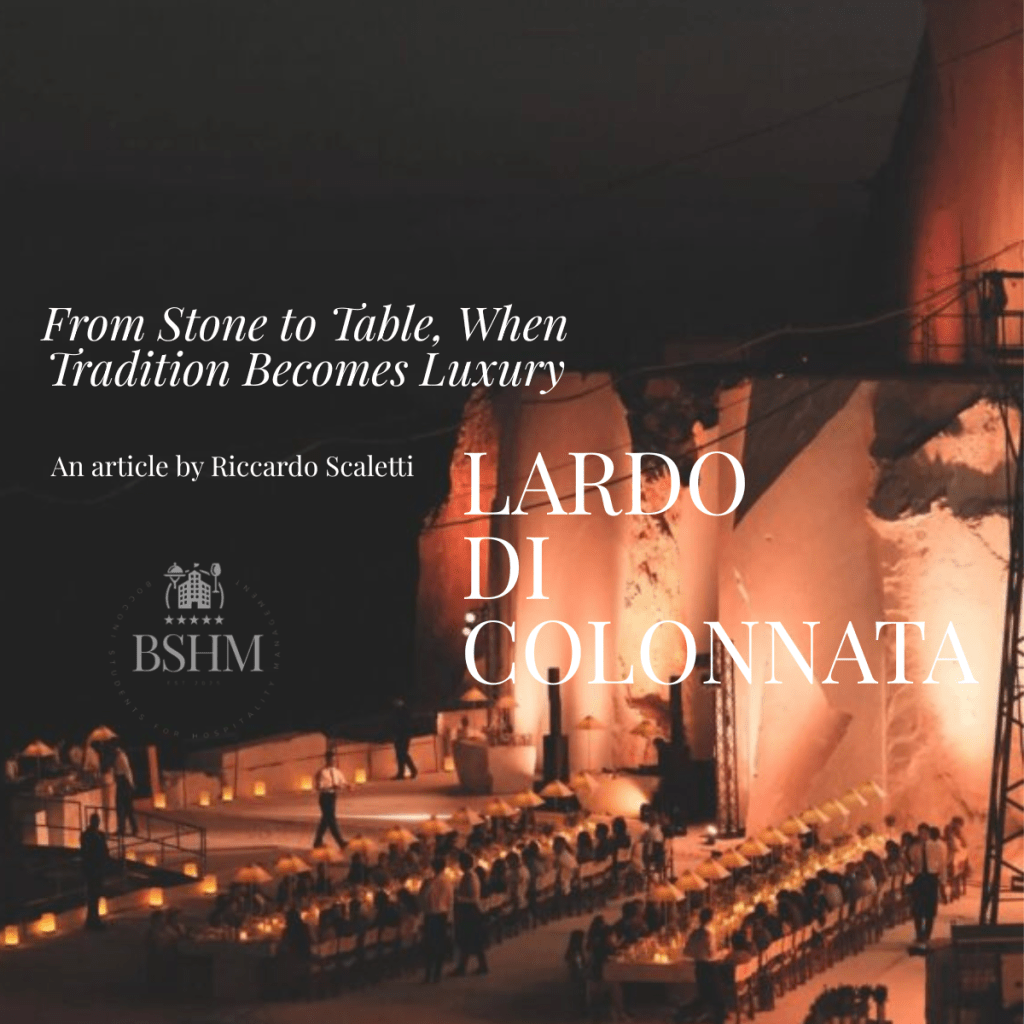
This unique dialogue between food, ma;er, and place has also turned Carrara into an increasingly sought-after setting for exclusive, invitation-only events, where gastronomy, brand identity, and landscape merge into a single experience. Over the years, the marble quarries have hosted private corporate dinners, luxury brand experiences, and high-end gastronomic events, chosen precisely for their raw, monumental beauty.
International brands such as Giorgio Armani, as well as other global luxury players, have selected the quarries of Carrara as the backdrop for refined dinners and product launches, transforming these industrial yet poeMc spaces into temporary dining rooms carved out of stone. Similarly, high profile corporate gatherings and gourmet events curated by fine-dining professionals have taken place deep within the quarries, where long tables, candlelight, and minimalist design coexist with towering marble walls.
What unites these events is not spectacle for its own sake, but a shared sensitivity toward place driven luxury. The marble landscape becomes more than a setting: it becomes part of the narrative, echoing the same values embodied by the Lardo di Colonnata. Just as lardo matures slowly inside marble vats, absorbing the character of the stone, these events draw meaning and authenticity from the quarry itself. Nature, tradition, and craftsmanship converge, closing a conceptual circle that begins with the lardo and returns to the marble from which it originates.
At its core, the story of Lardo di Colonnata is a story about Mme, paMence, and place. What begins as a simple ingredient, born from necessity, shaped by tradition, and matured inside marble vats, evolves into something far greater. The lardo carries within it the memory of Carrara: the stone, the labour, the landscape, and the quiet intelligence of artisanal knowledge passed down through generaMons.
Its journey from the daily food of quarry workers to the plates of Michelin-starred chefs reflects a broader truth in contemporary gastronomy and luxury. True value does not come from excess or complexity, but from authenticity, origin, and meaning. When respected and thoughtfully transformed, even the most humble ingredient can become a luxury product, one that speaks not only to taste, but to culture and identity.
Carrara itself mirrors this transformation. Once seen solely as a place of extraction, it has become a desMnaMon and a stage, where food, craftsmanship, and landscape converge in unforge;able experiences. From the marble vats that cradle the lardo to the quarries that host exclusive dinners and global brands, the territory closes the circle, reaffirming its role as both origin and inspiration.
The lesson is clear: in food and beverage, as in luxury, what truly endures is not spectacle, but the ability to turn heritage into contemporary value. When a product, a place, and a story are aligned, the result is not just a dish or an event, but an experience that resonates, long after the table is cleared.
Written by Riccardo Scaletti


Leave a Reply