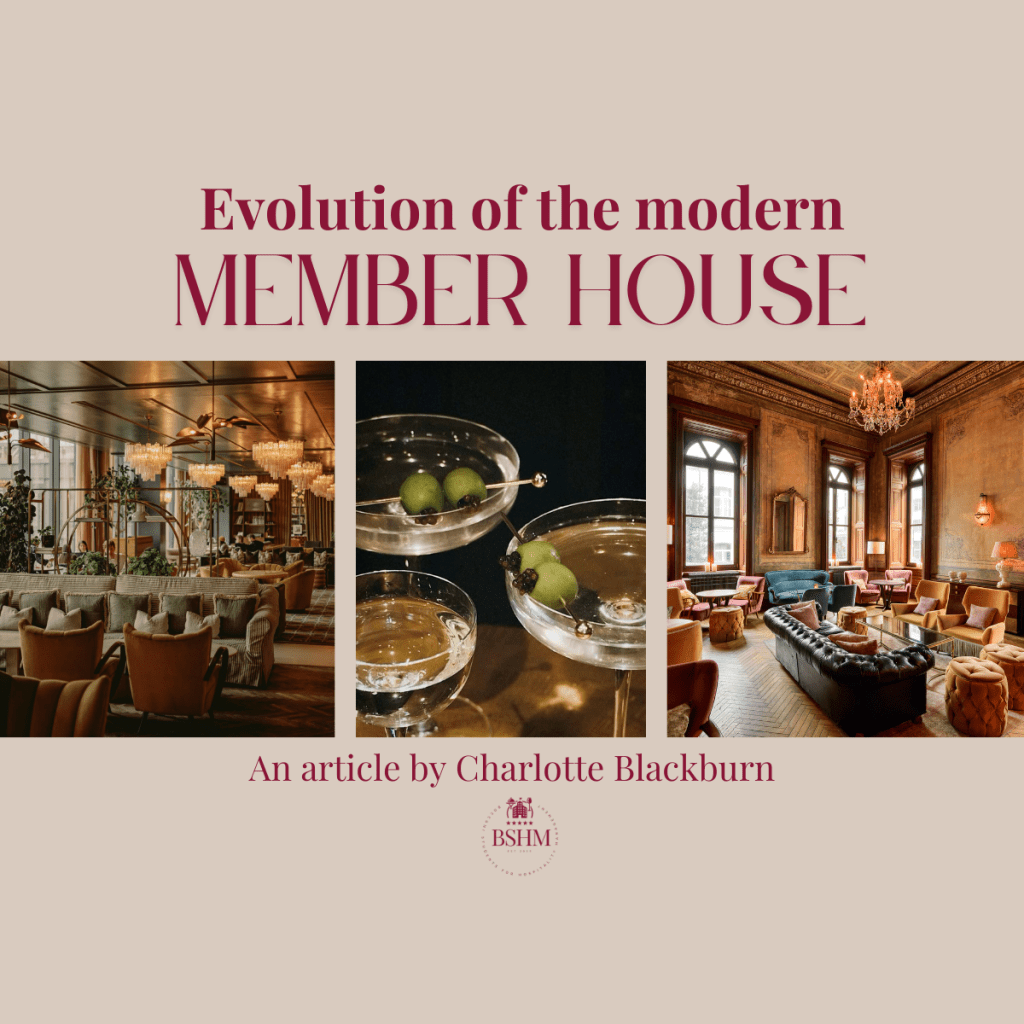
What was once the domain of the elite, defined by exclusivity and heritage, member houses have become a lifestyle-driven community focused on experience, design, and belonging. Historically, member houses were private clubs created to offer comfort, privacy, and prestige to society’s elite. Indeed, it was the case for the Royal Automobile Club and the Reform Club that were established in 19th-century London as spaces where influential figures could meet, dine, and network away from the public eye. At the time, it was a space that first belonged to men, built as their sanctuary. Membership was limited and selective, often based on profession or background, and done through recommendations. These clubs were built around tradition and discretion rather than commercial strategy; offering dining rooms, libraries, and lounges for members to conduct business and socialise in private.
At the beginning of the 20th century, there was a transition, driven by a younger generation which wanted to be a part of these clubs and use them as a place of connection and collaboration rather than formality and hierarchy. Hence, it led to the opening of Soho House in London in 1995 transforming the concept of member houses since unlike its predecessors, Soho House embraced inclusivity from the start, welcoming both men and women as equal members. It was seen as an approach reflecting a broader cultural shift. Additionally, by targeting the creative community instead of the traditional upper class, it offered a casual and curated environment that balanced social and professional life. With its design-led spaces and cultural programming, Soho House set a new standard for what membership hospitality could be. Later on, in order to stay relevant and target the younger audience, Soho House introduced the “Under 27” membership, offering reduced rates for younger members and prioritising early-career creatives. They also attempted to maintain the exclusive aspect of member houses by prohibiting the use of pictures. By engaging younger members early, the brand created a lasting connection that continued as they advanced in their careers. This also inspired other clubs to adopt similar models, recognising that a sustainable member base depends on generational diversity and therefore they decided to focus more on the creativity aspect of each member.
Today’s member houses combine elements of hotels, workspaces, and social clubs. These spaces have areas to work, relax, and socialise.
Marketing of member houses has also evolved alongside this shift. Traditionally, advertising played a small role since it was based solely on reputation and exclusivity. It is said that being seen entering a club like the Royal Automobile Club was of itself a statement of social standing, invisibility was the marketing. Nowadays, modern member houses focus on visibility and experience, their advertising is done by word of mouth, and immersive programming such as events, art exhibitions, live music, and talks. By the creation of co-working concepts such as Soho Works it allows the relationship to go beyond physical spaces and to immerse themselves completely in the member’s life.
For the hospitality industry, in many ways, member houses embody the evolution of hospitality management itself, shifting from service delivery to experience design, and from guest satisfaction to lasting community engagement. Indeed, the customer’s priorities nowadays have changed as they want more than just services and search for a shared sense of purpose.
From the heritage of the Royal Automobile Club to the global reach of Soho House, the member house has evolved from a symbol of exclusivity into a model for modern hospitality, one that blends luxury, lifestyle, and community in a way that continues to shape the industry’s future.
Article by Charlotte Blackburn
 Bocconi Students for Hospitality Management
Leave a comment