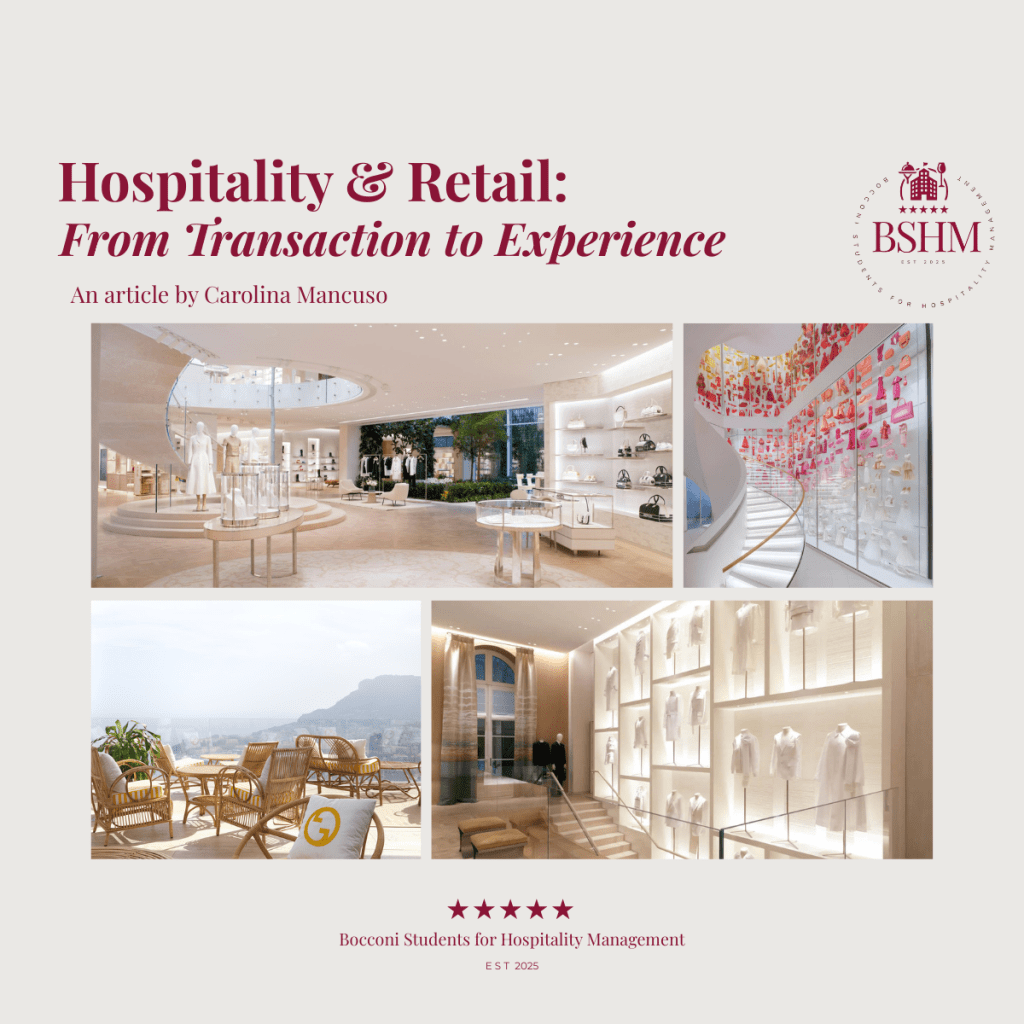
Luxury retail is undergoing a quiet but profound transformation: the store is no longer just a place for selling, but a place for staying. Brands are increasingly learning from the world of hospitality, embracing the principles of hotellerie – genuine care, atmosphere, and service – to create environments that make people feel welcome rather than rushed. The new ambition is not simply to sell, but to host; not to offer a product, but to invite someone into the brand’s world.
This shift is visible across the world’s great maisons. At Gucci’s Giardino 25 in Florence or Armani’s Ristorante & Caffè in Milan, hospitality becomes an extension of the brand’s identity – espresso, ambience, and design all speaking the same aesthetic language. Dior’s flagship on Avenue Montaigne invites guests into a world that blends a boutique, a café, a gallery, and a haute couture atelier under one roof, inviting guests on a journey through the brand’s heritage. Louis Vuitton follows this philosophy through its “Maisons,” where art, gastronomy, and fashion intertwine: at its Paris and Seoul locations, exhibitions, lounges, and even private apartments replace the traditional retail rhythm with the pacing of a hotel stay.
The design of these spaces reflects that same evolution. Layouts are open and unhurried, materials are tactile and domestic; lighting flatters; scent lingers softly in the air. There are places to sit, sip, or simply pause. Every element suggests that you are a guest, not a buyer. Even the fitting room becomes an intimate retreat, looking and feeling more like a suite, crafted to slow time and enhance comfort.
The people within these spaces embody this new philosophy too. Luxury sales teams are being trained not as vendors but as concierges: discreet, intuitive, attentive. Their role is to anticipate needs, not to push products. It is a service model built on emotional intelligence: less persuasion, more presence.
This “hotelization” of retail reflects a larger truth about modern luxury: people seek emotional engagement, not just ownership. A beautiful object can be bought anywhere; what remains rare is how it is offered. The best boutiques now feel like the world’s finest hotels: places where every gesture is thoughtful, every encounter personal, and every goodbye carries the promise of return.
Hospitality has thus become the new frontier of luxury retail. The most visionary brands understand that they are no longer just selling fashion – they are curating moments of presence, designing atmospheres of comfort, and perfecting the art of welcome. In the end, this is what defines modern luxury – because the ultimate luxury is not what you buy, but how you are made to feel.
Article by Carolina Mancuso
 Bocconi Students for Hospitality Management
Leave a comment