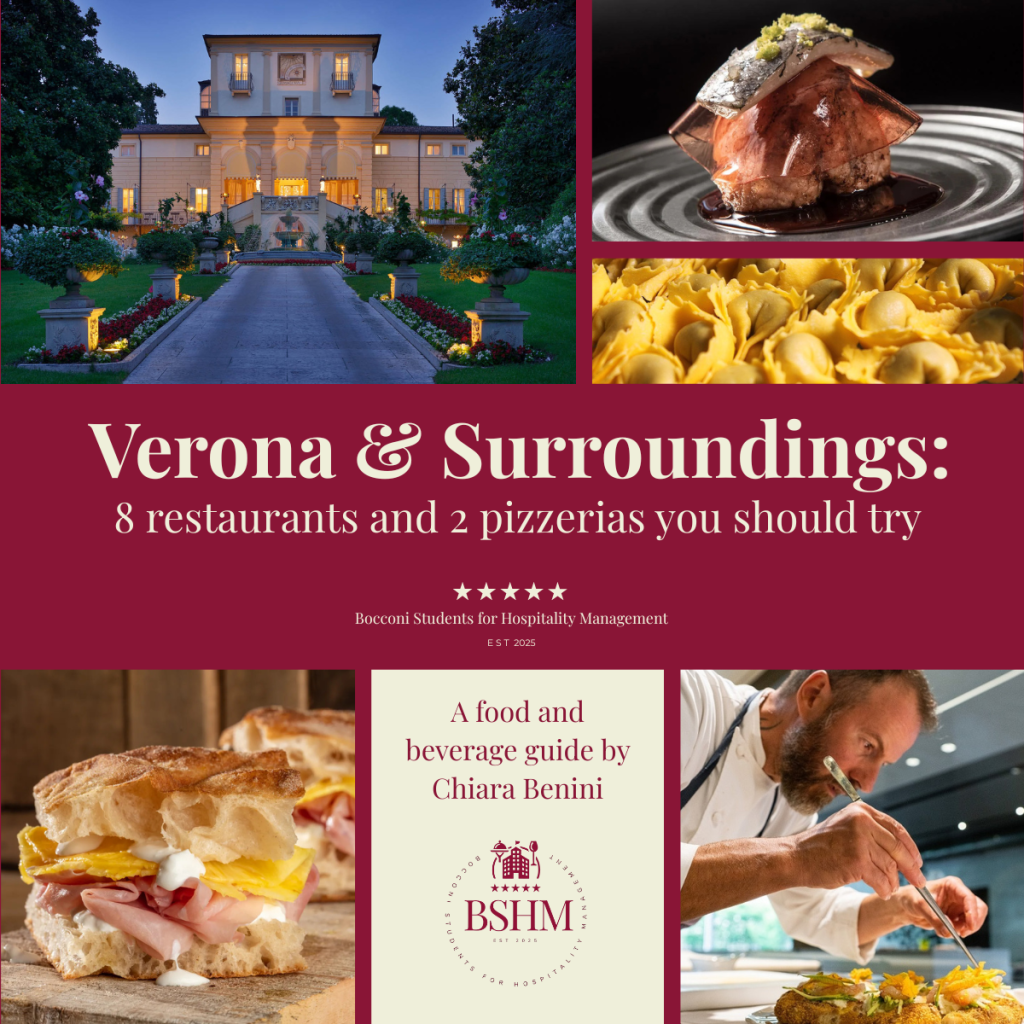
In the heart of Veneto, Verona mixes history, beauty and great taste. Among the hills of Valpolicella and Lake Garda, its cuisine ranges from refined gastronomy to heartfelt tradition.
Here, chefs pay homage to their local roots with creativity and precision; it is the place where even pizza becomes craftsmanship and each dish mirrors the soul of this timeless city.
Let’s begin our journey through Verona’s most unforgettable tables:
• Casa Perbellini 12 Apostoli
Today, in the spaces of the historical sign “12 Apostoli” stands the new “Casa” of Giancarlo Perbellini, a 3-Michelin starred chef. The atmosphere and the scents of an informal place welcome the guests, who, crossing the Vòlto room and the Affreschi room, reach the Chef’s table; where barriers disappear to live a kitchen-view interactive and intimate experience. All the twelve guests will follow the tasting experience “Io e Silvia”, which includes imaginative dishes (such as pigeon and langoustines accompanied by carrot, apple and pistachio) and other four surprise dishes.
• Ristorante Il Desco
For over forty years, it has been Verona’s finest drawing room, situated within the walls of a Renaissance palace in the heart of the Scaliger city. The menu tells the family’s gastronomic story, born from the talent of father Elia Rizzo, who obtained a Michelin star, reconfirmed year after year, and today carried on by his son Matteo. Most of today’s dishes are distinguished by a fresh touch, without however abandoning the forefather’s classic recipes. Not to be missed is the interesting “Chapter 43” tasting menu: a journey through tradition, territory and iconic dishes, from 1982 to today.
• Antica Bottega del Vino
The historic wine bar and restaurant dates back to the 15th century, changing hands and name a few times since opening. Firstly, it became well known on an international scale after the purchase of Severino Barzan and Raffelo Cedro in the 1980s, then changed hands once again and now belongs to an association called “Famiglie storiche”. Boasting over 18,000 wines, including many from Valpolicella and other Veneto regions, this is certainly the best place for a wine experience; which can be also accompanied by a proper meal. A must-try is the traditional risotto made with the local wine Amarone.
• Ristorante Oseleta
In the delightful setting of the exclusive five-star hotel “Villa Cordevigo Wine Relais” in Cavaion Veronese, the Oseleta Restaurant conquered its sought-after Michelin star. The guests are invited to take part in a journey of senses through chef Marco Marras’ culinary workshop, which ranges across seafood, vegetarian, Garda’s lake-inspired and meat dishes. Among his signature creations, the “Fusillone…my way” stands out: perfectly al dente pasta with bagna cauda, borage, saffron, roasted eggplant and cuttlefish ink; the sauces evoke both marine and earthy sensations on the palate.
• Vecchia Malcesine
Situated in a small alleyway in a peaceful spot above the historic centre of Malcesine, this restaurant opens on to a surprising garden planted with olive trees and boasting fine views of Lake Garda. The restaurant is run by chef Leandro Luppi, originally from the Alto Adige, who has been creating superb cuisine in this region for over 20 years and is renowned for his skillful and imaginative dishes. He now showcases his creative, personalized recipes on two tasting menus: “Qcina 24” features his latest creations, while “Our Classic” is dedicated to his iconic specialties.
• Ristorante Amistà
Housed within the enchanting Byblos Art Hotel, Amistà reflects the colorful, dreamlike world of the villa itself, where history and contemporaneity coexist happily. The cuisine philosophy of the Executive Chef Mattia Bianchi is rooted in a meticulous and focused search for ingredients: excellences from Valpolicella and the Verona area, carefully selected from sustainable local markets, combined with a flair for innovation and the ability to surprise with oriental aromas and flavors; they are offered through three different tasting menus, one of which is entirely vegan.
• Trattoria ai Caprini
At the beginning of the twentieth century, two young spouses started this Trattoria, offering simplicity, typical dishes and Valpolicella wine. The commitment to culinary excellence is rooted in the tradition of their family, where it has been passed down for four generations. The experience in this Trattoria is unique since it does not end at the end of the meal, but continues in the laboratory, where cooking classes are organized for the preparation of pasta.
Here, the homemade lasagnette con ragù della Pierina and the tagliatelle in broth with the livers are a must-try.
• Ristorante Alla Borsa
Founded in 1959, the restaurant owes its name to the fact that, originally, the place was a place where merchants negotiated the price of the food; indeed, it was the “Borsa merci”. The owner, Nadia Pasquali, is a leading figure in pasta craftsmanship in the Custoza hills and consequently throughout Italy.
The flagship product of the restaurant, which also is the iconic product of Valeggio sul Mincio, is the “knot of love”, a type of tortellino, called this to distinguish it from the more famous tortellino from Bologna, the “navel of Venus”.
• Pizzeria I Tigli
With almost 30 years of experience behind him, Simone Padoan knows how to make difficult things easy: he uses a mix of wholemeal flours and pays meticulous attention to natural leavening processes to create a dough which has a crispy crust yet soft interior. He also focuses on different types of toppings, including fish, meat and vegetables — whether your preference is for traditional or more imaginative pizzas, every option is of the highest quality.
• Pizzeria Renato Bosco
In San Martino Buon Albergo, he began a deep reflection on pizza, starting with the dough-making techniques and the quality of the flours and continuing on to the leavening techniques. It is a new perspective on pizza, similar to that of his neighbor Simone Padoan, who designed the concept of the Italian pizza substantially as a round pizza presented in slices and with a different structure than the Neapolitan type. Renato Bosco distinguishes himself for the lightness of his pizza and for his research that is forever centered on the “crunch effect”.
Article by Chiara Benini
 Bocconi Students for Hospitality Management
Leave a comment