
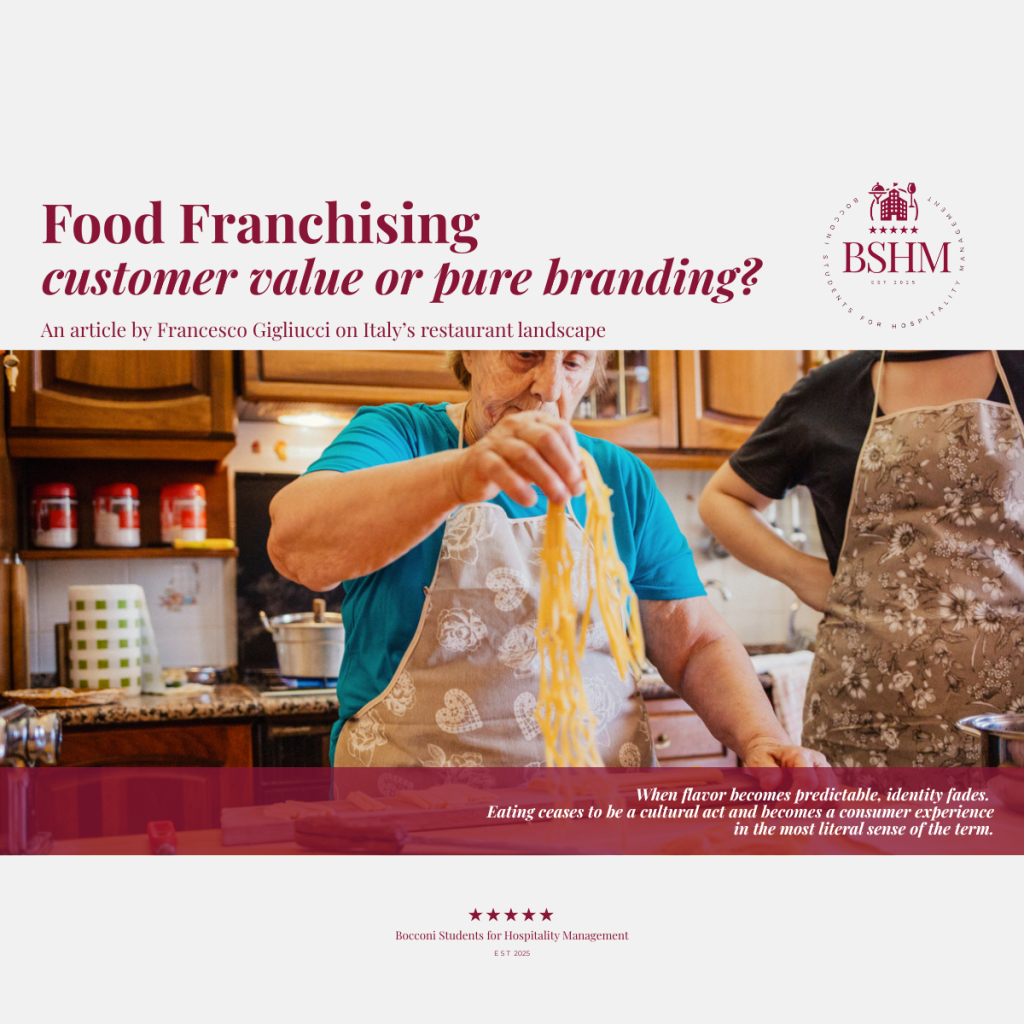
In recent years, Italy’s restaurant landscape has transformed. Driven by the need for speed and cost control, some brands have multiplied rapidly, while the idea of “Italian authenticity” has become a scalable, repeatable, and universally recognizable product. More than an evolution in dining, food franchising today represents a new way of experiencing taste: a network of places replicating the same atmosphere in every city. In this serial perfection, it tries to convince us that authenticity can, in fact, be standardized. Yet behind all the rhetoric surrounding Italian cuisine, a question naturally arises: are we still nurturing and sharing our culinary culture with customers, or merely reproducing its value through economies of scale and marketing strategies? Of course, there’s something appealing about finding a brand that promises the same experience hundreds of kilometers away. It’s the reassurance of the familiar, the guarantee of a dish whose qualities you already know, a menu that doesn’t surprise but doesn’t disappoint, a logo that make you feel at home wherever you go. However, the most authentic side of Italian gastronomy, the one preserved and passed down through the most traditional practices, is anything but uniform or standardizable. Our culinary identity thrives on nuance and tiny differences: the same dish can have dozens of variations within just a few kilometers. The pasta changes, the ingredients change, and so do the hands that prepare them. And it is precisely the cook’s hand, more than the recipe itself, that brings flavor to life. In the franchising world, by contrast, every gesture is codified. Every dish is born from a technical sheet, not from intuition. It’s cooking as an algorithm: efficient, replicable, but devoid of unpredictability. And in that absence of error, the taste of truth is lost. For customers, franchising offers something independent restaurants often struggle to guarantee: predictability. You know what to expect, how much you’ll spend, and what the dish will be like. It’s comfort in the purest sense of the word. But even comfort has a price. When flavor becomes predictable, identity fades. Eating ceases to be a cultural act and becomes a consumer experience in the most literal sense of the term. Thus, the word “quality,” already overused, ends up meaning consistency rather than excellence. A winning formula in market language, bringing all the benefits of efficiency, yet at the cost of an ever-weakening gastronomic message. That’s why today, the most “authentic” recipes are born less from pots and pans and more from carefully constructed narratives. Design, music, the tone of social media posts—everything contributes to shaping an image of Italianness that is polished yet artificial. Our cities, in turn, become stage sets for a play starring Italian cuisine. And in this fragile balance, branding takes on a role as vital as ingredient quality or the cook’s skill, filling the void left by a fading culinary identity. In the franchising world, everything moves fast: dishes, processes, openings. But Italian cuisine was never meant to rush. It lives in hesitation, in cooking mistakes that became memories, in imprecise timings that created unrepeatable flavors. And perhaps it is there, in imperfection, that the truest essence of our taste resides. If and when the dynamism and standardization of franchising can learn to dialogue with the slowness of the gestures and stories that shape Italy’s culinary tradition, then this model, in its most mature form, will truly express its full potential, becoming not only an economic success but also a cultural asset for Italy.
Article by Francesco Gigliucci
 Bocconi Students for Hospitality Management